In a sunlit ward of the Hematology & Oncology Department at Beijing Jingdu Children's Hospital, 14-year-old Xiaochen (alias) was animatedly chatting and laughing with his father. Sunlight streamed through the window onto his rosy cheeks.
"Auntie Xiao is here!" the boy's eyes lit up the moment Dr. Xiao Juan stepped through the door, and he immediately moved to hop off the bed and run toward her.
Dr. Xiao waved her hand and walked over with a smile. "Your recovery is going wonderfully — well done!"
Who could have imagined that a year ago, when this teenager first arrived at the hospital, both hands drooped limply at his sides like they were paralyzed. He couldn't even hold a bowl, and his feet were completely unable to walk. Today, he can bounce out of bed and throw up a cheerful victory sign for the camera.
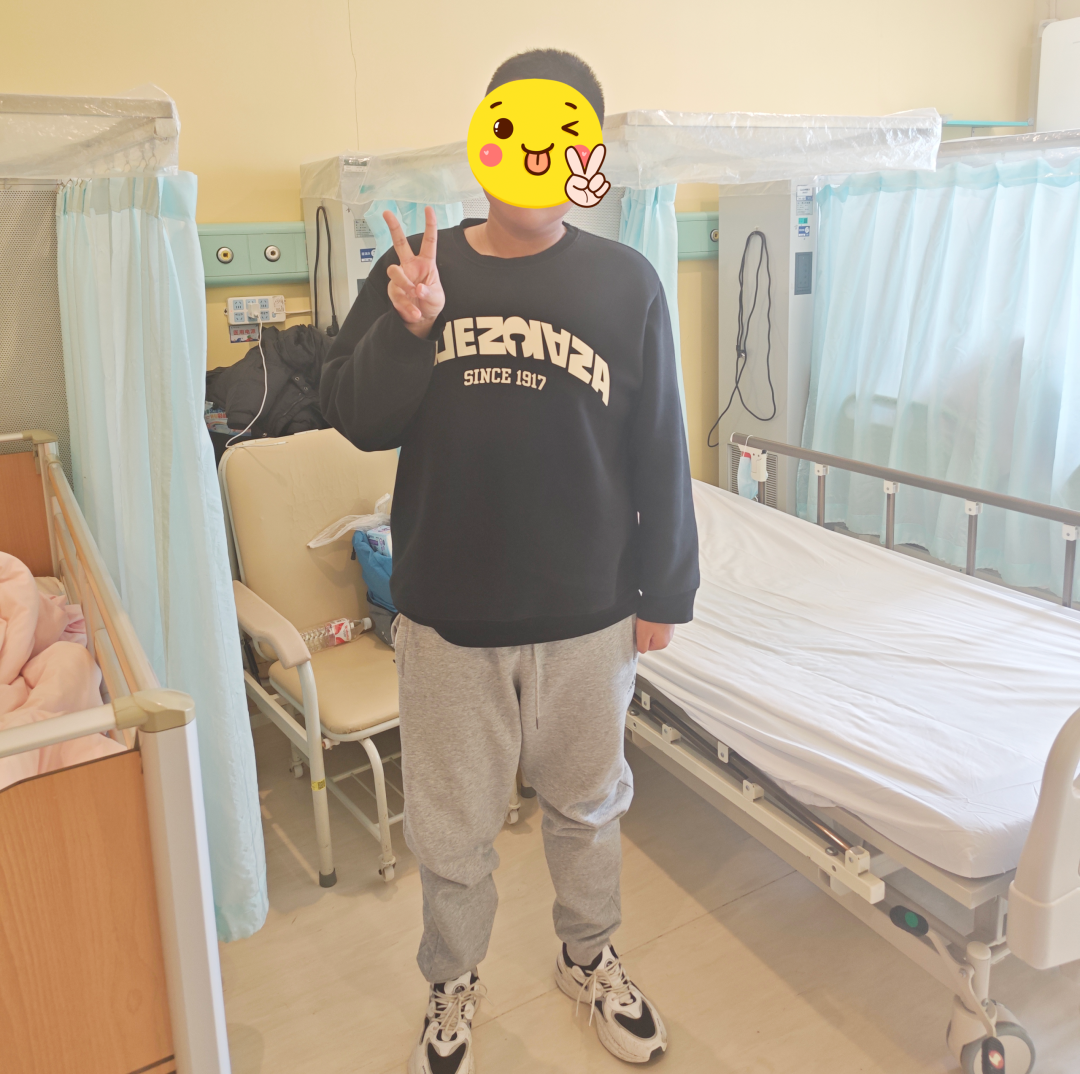
After a year of personalized treatment, Xiaochen can walk freely and strike a joyful pose.
A Fever That Changed Everything
Rewind to the summer of 2024.
Xiaochen was running a persistent high fever. A routine blood test at a community clinic showed critically low blood counts. His family rushed him to a major hospital in Tianjin, where further tests delivered a devastating diagnosis: acute promyelocytic leukemia (APL, M3 subtype) — an aggressive hematologic malignancy.
The teenager began a grueling chemotherapy regimen. Just when the disease seemed to be responding and the family dared to hope, a new blow struck.
Severe peripheral neuropathy — a serious complication of chemotherapy. Gradually, Xiaochen lost sensation and strength in his hands and feet. Eventually, even walking became impossible.
"His hands just drooped down, like he was paralyzed." Dr. Xiao Juan later described the situation. "One was that his hands couldn't move; the second was that his feet couldn't move. He couldn't walk, and he couldn't even hold a bowl to eat."
A 14-year-old boy, who had just ignited hope of defeating leukemia, now found himself trapped in a body that refused to obey. After three months of treatment in Tianjin, his neuropathy symptoms showed no significant improvement. The family searched everywhere for options and, through a friend's recommendation, arrived at Beijing Jingdu Children's Hospital's Hematology & Oncology Department.
A Personalized Treatment That Turned the Tide
When Dr. Xiao Juan took over Xiaochen's care, she conducted a comprehensive assessment of his condition. The situation was indeed complex: the leukemia required continued treatment, yet the severe peripheral neuropathy meant he could no longer tolerate conventional-intensity chemotherapy.
Under the leadership of Professor Wu Minyuan (recipient of the State Council Special Allowance) and Professor Wu Nanhai, the team made a decisive move: they would design a personalized treatment protocol tailored specifically for Xiaochen. On one hand, they would control the leukemia while preserving space for nerve recovery. On the other, nerve-nourishing medication and rehabilitation therapy would proceed in parallel.
"The team fine-tuned the medications while delivering rehabilitation and supportive therapy for the child. Slowly, Xiaochen not only regained the ability to walk, but his hand function also returned."
Step by step, the milestones accumulated: from gripping a spoon, to lifting a small bowl, to eating on his own, to writing again. Every tiny advance brought genuine joy to the medical staff watching over him.
For many children, a hospital stay is monotonous. For Xiaochen, the ward became the stage where he witnessed his own progress, inch by inch.
And for Dr. Xiao Juan and her team, watching a child who once lay powerless in bed now stand in the ward, flashing a cheerful "V" sign — that is the greatest achievement of their profession.
Hope Growing Quietly in the Ward
The hardest pages of the hospital diary have finally been turned. Today, Xiaochen has stopped all chemotherapy medications, and follow-up tests show all indicators remaining consistently stable.
"I've finished treatment now — I'm recovering incredibly well!"
Xiaochen's voice overflows with undisguised happiness and gratitude. "Thank you, Grandma Wu (Prof. Wu Minyuan), Grandpa Wu (Prof. Wu Nanhai), and Auntie Xiao (Dr. Xiao Juan). Once this follow-up visit is done, I can go back to school!"
Xiaochen's story shines like a beam of light into the hearts of every child still undergoing treatment. It tells everyone: no road is too difficult for miracles to appear; no illness is too heavy for recovery to be possible. And that hope, right now, is quietly growing in the wards of Beijing Jingdu Children's Hospital's Hematology & Oncology Department.
About the Hematology & Oncology Department
The Hematology & Oncology Department is one of the hospital's flagship specialties. Its expert team is led by renowned figures in pediatric blood disorders, including Professor Wu Minyuan (State Council Special Allowance recipient) and Professor Sun Yuan (Hospital President and Department Director). The department is designated as a Beijing Basic Medical Insurance Hematopoietic Stem Cell Transplant Institution, a China Marrow Bank-registered collection and transplantation hospital, and the national lead center for multicenter collaborative studies on HSCT for pediatric hemophagocytic lymphohistiocytosis (HLH) and autologous cord blood therapy for acquired aplastic anemia. It is widely recognized as one of China's premier pediatric hematology-oncology centers.
The department comprises seven units: Ward 7 (Solid Tumor Ward), Ward 8 (Transplant Ward), Ward 9 (Hematology Ward), the International Department, two transplant units, a central laboratory, a hematology outpatient clinic, a PICC clinic, and a comfort-care treatment unit. Together, these facilities offer 150 beds and 19 Class-100 laminar-flow transplant rooms.
The department has extensive expertise in treating:
- Leukemias and lymphomas — all subtypes, including APL (M3), ALL, AML
- Hemophagocytic lymphohistiocytosis (HLH)
- Chronic active EBV infection
- Bone marrow failure disorders — acquired aplastic anemia, Shwachman-Diamond syndrome, Fanconi anemia, congenital neutropenia, congenital pure red cell aplasia, dyskeratosis congenita
- Primary immunodeficiency diseases — Wiskott-Aldrich syndrome (WAS), severe combined immunodeficiency (SCID), very-early-onset inflammatory bowel disease, hyper-IgM syndrome, hyper-IgE syndrome, chronic granulomatous disease
- Inherited metabolic disorders — Gaucher disease, Niemann-Pick disease, mucopolysaccharidosis, adrenoleukodystrophy, metachromatic leukodystrophy
- Solid tumors — neuroblastoma, hepatoblastoma, Wilms tumor, retinoblastoma, atypical teratoid/rhabdoid tumor (ATRT), germ cell tumors, medulloblastoma, and more
As one of China's largest pediatric transplant centers, the department has completed over 900 hematopoietic stem cell transplants since its founding, performing approximately 100 transplants annually.
Seeking Expert Pediatric Hematology Care?
Beijing Jingdu Children's Hospital welcomes patients from over 100 countries. Our International Patient Center provides end-to-end support for families traveling to China for treatment.
Book a Consultation →