On October 30, 2025, the transplant ward at Beijing Jingdu Children's Hospital welcomed a very special young warrior: 10-year-old Sasha from Russia.
His medical history read like a five-year chronicle of a family's endurance: acute lymphoblastic leukemia, early relapse, international treatment, a first transplant, recurrence after transplant, and finally CAR-T therapy that did not achieve durable response.
When Sasha and his parents crossed continents and time zones to reach Beijing, the clinical team faced far more than a critically ill child. They encountered a body worn down by repeated treatment, a family exhausted emotionally and financially, and the extra weight of language and cultural barriers in an unfamiliar country.
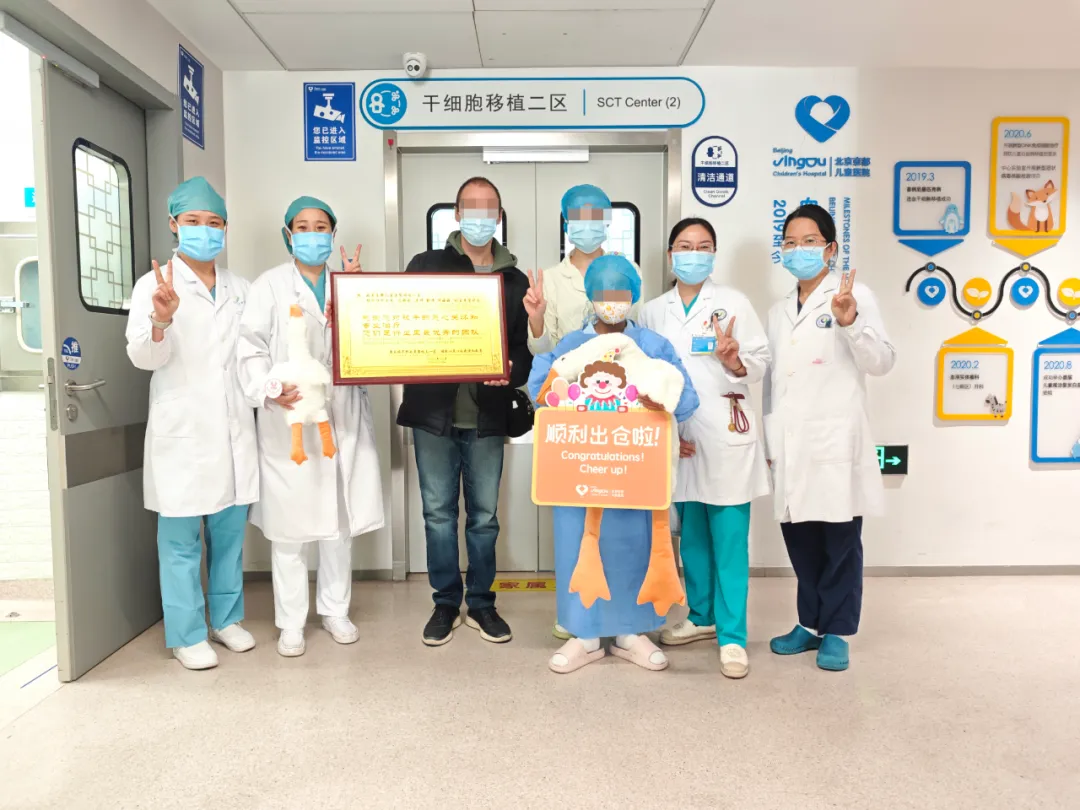
Sasha and his family thank the transplant team with a bilingual plaque after successfully leaving the transplant unit.
A Second Chance, Engineered with Precision
Under the leadership of President Sun Yuan, Director Wu Nanhai, Director Xiao Juan, Director Liu Zhouyang, and attending physician Dr. Jiang Lingli, the team stabilized Sasha's disease and prepared him for transplant.
On November 10–11, 2025, Sasha received a father-to-son haploidentical hematopoietic stem cell transplant with a 7/12 match. On December 1, 2025, after rigorous post-transplant management, he successfully discharged from the transplant unit.
Transplant type: Haploidentical HSCT (father donor, 7/12 match)
Transplant dates: November 10–11, 2025
Discharge date: December 1, 2025
Total inpatient transplant period: 32 days
When the Body Pushes Back
Sasha's post-transplant course was anything but ordinary. Years of prior therapy had left his body fragile, and complications emerged rapidly:
- Severe gastrointestinal toxicity: nausea, vomiting, abdominal pain, and diarrhea exceeding 20 episodes per day
- Cardiac dysfunction
- Coagulation abnormalities
- Drug-induced hypertension
- Cyclosporine intolerance
Each complication threatened the delicate balance required for engraftment and recovery. The medical team responded with precise adjustments, continuous monitoring, and rapid intervention.
Bridging Language and Fear
Beyond physiology, the team had to bridge a gulf of language and anxiety. How could Sasha's mother understand complex medication instructions? How could the nurses reassure her during the longest nights?
Head Nurse Yang Xinxin led the formation of a dedicated Sasha nursing team. Under Director Xiao Juan's guidance, they adopted a care motto: “Meticulous care knows no borders; heart-to-heart communication has no distance.”
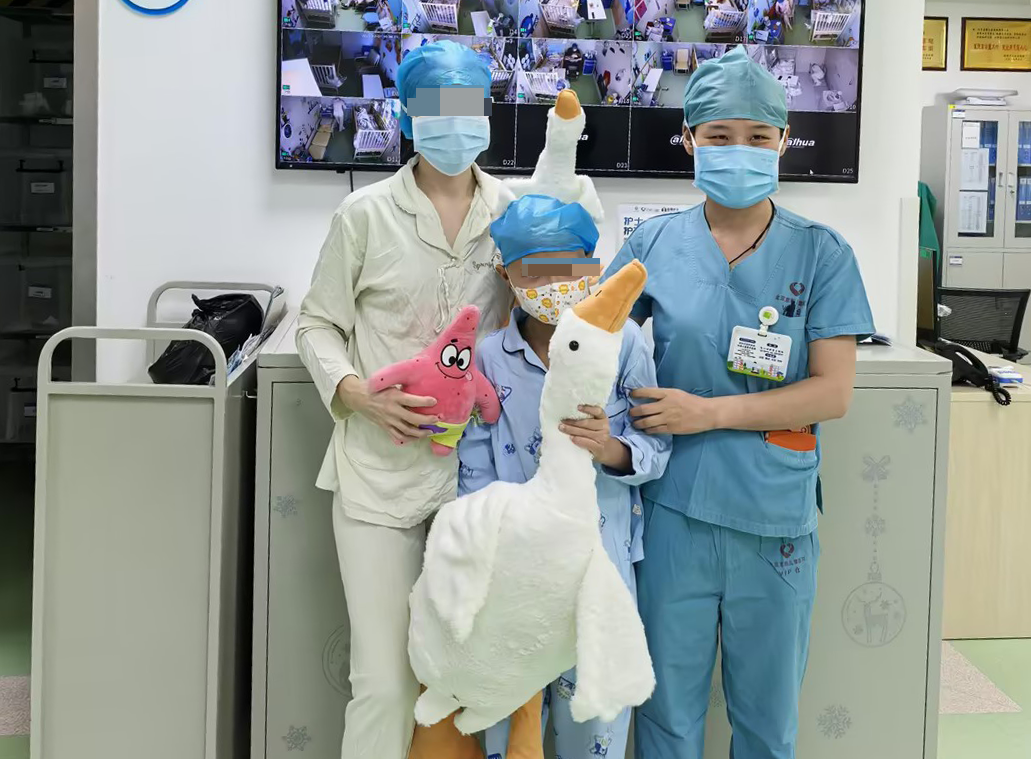
A nurse stands with Sasha and his mother during the transplant journey, offering both clinical care and emotional support.
Personalized Care, Down to the Smallest Detail
For Sasha's severe diarrhea, the team designed an individualized perianal care protocol using the softest materials and gentlest technique. Remarkably, throughout the entire transplant period, Sasha developed no serious oral or perianal mucosal breakdown or infection.
Heart function, blood pressure, and coagulation markers were woven into a dynamic monitoring network. Any subtle change triggered an immediate, coordinated response.
Care That Speaks Every Language
The nursing team translated daily medication instructions into Russian, paired them with pictures, and sent them to Sasha's mother via WeChat one by one. Every drug's purpose, timing, and possible side effects became clear.
They created an exclusive WeChat group named the “Sasha Guardians” — a channel that served as information hub, emotional lifeline, and child psychology support platform all at once. Daily plans, lab results, dietary advice, and nursing priorities were shared in real time. Nurses used translation apps, simple gestures, and a steady stream of encouraging stickers to say, “We are with you.”
When they learned Sasha's favorite things, the team shared pictures and short videos to cheer him up. They even learned a few Russian phrases: “You are amazing,” “Don't be afraid.”
“If the nurses could understand Russian, I would definitely say a special thank you.”
When this message reached the nursing station, more than one nurse wiped away tears. The child's gratitude became the team's greatest fuel.
Toys, Smiles, and a Big Goose
At Beijing Jingdu Children's Hospital, healing is not only about medicine — it is also about joy and hope.
The nurses bought toys and built a colorful “toy corner” inside the sterile laminar-flow chamber, bringing life to a space that can feel cold and isolating. After 32 days of unwavering care, the team presented Sasha with a large plush goose he had long wished for. When he hugged it and broke into a bright, long-missed smile, every ounce of fatigue melted away.
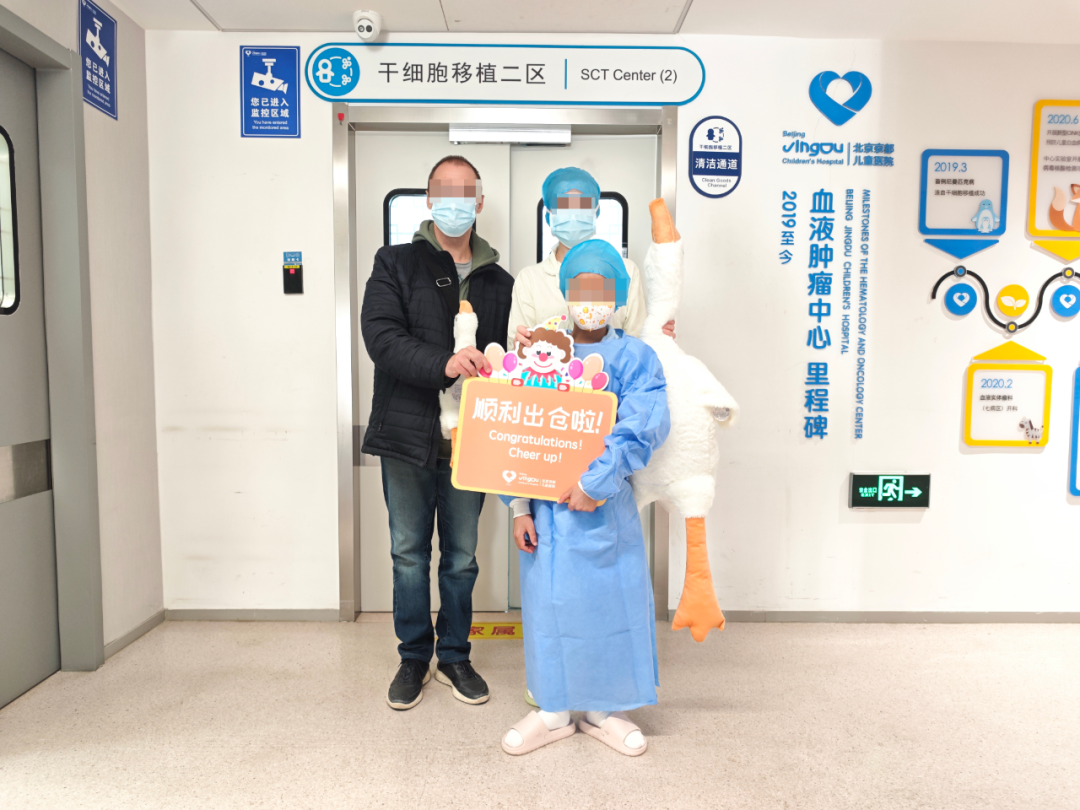
Sasha clutches the plush goose gifted by the nurses, a symbol of the warmth that carried him through transplant.
On discharge day, Sasha and his mother presented Head Nurse Yang Xinxin's team with a plaque inscribed in both Chinese and Russian:
“Thank you to the team for your attentive care and professional treatment of our child. You are the best team in the industry.”
— The Knutov family, Russia
This gratitude from across the border was not only recognition of clinical skill, but also a tribute to the human warmth the team wove into every interaction.
The Road Ahead
Sasha's battle is not yet over. Discharge from the transplant unit is only the first step on a longer road of immune reconstitution, possible graft-versus-host disease, and ongoing follow-up.
Yet his 32-day journey already proves a powerful truth: on top of advanced medical technology, meticulous, human-centered, culturally sensitive care is the other wing that lifts lives and creates miracles.
For Sasha, the staff at Beijing Jingdu Children's Hospital are not only caregivers. In a foreign land, they have become his temporary but steadfast family. The team will continue to walk beside him and his parents, step by step, with the same professionalism and warmth.
About the Hematology & Oncology Department
The Hematology & Oncology Department is one of the hospital's flagship specialties. Its expert team is led by renowned pediatric blood disorder specialists Professor Wu Minyuan (recipient of the State Council Special Allowance) and Professor Sun Yuan (Hospital President and Department Director). The department is designated as a Beijing Basic Medical Insurance Hematopoietic Stem Cell Transplant Institution, a China Marrow Bank-registered collection and transplantation hospital, and the national lead center for multicenter collaborative studies on HSCT for pediatric hemophagocytic lymphohistiocytosis (HLH) and autologous cord blood therapy for acquired aplastic anemia. It is widely recognized as one of China's premier pediatric hematology-oncology centers.
The department comprises seven units: Ward 7 (Solid Tumor Ward), Ward 8 (Transplant Ward), Ward 9 (Hematology Ward), the International Department, two transplant units, a central laboratory, a hematology outpatient clinic, a PICC clinic, and a comfort-care treatment unit. Together, these facilities offer 150 beds and 19 Class-100 laminar-flow transplant rooms.
As one of China's largest pediatric transplant centers, the department has completed over 900 hematopoietic stem cell transplants since its founding, performing approximately 100 transplants annually.
International Pediatric Transplant Care
Beijing Jingdu Children's Hospital welcomes patients from over 100 countries. Our International Patient Center supports families through every step of treatment, travel, and recovery.
Book a Consultation →